Should You Hire an Automation Consultant or Buy Software?
There are two tabs open. One is a pricing page for a product that claims to handle the exact thing eating your Tuesdays. The other is a half written email to somebody who builds this for a living.
Both feel responsible. They can't both be right.
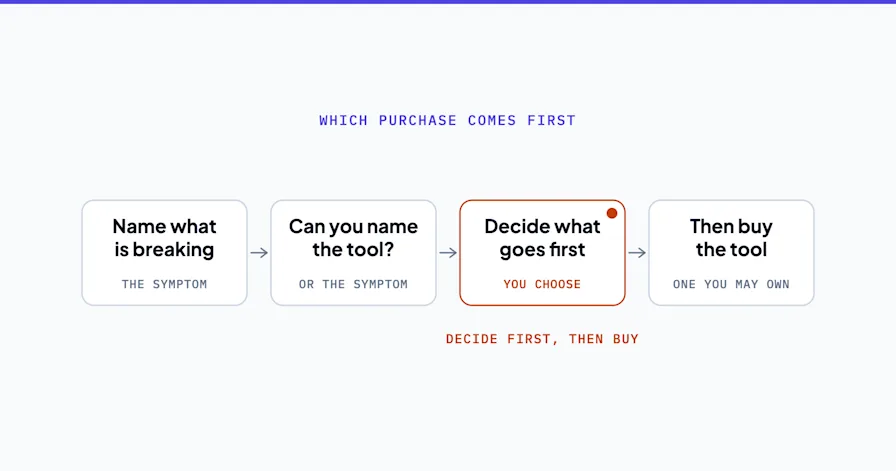
The short version, before anything else. Automation consultant or buy software? Decide by what you can name. If you can name the tool and describe exactly what it should do, buy the software. If you can only name the symptom, the missed follow ups, the retyping, the thing that slips when someone is out, you're not shopping for a product yet.
You're shopping for a decision.
You already know the tools are good. This is not an article about how software will let you down. It is about the fact that the two purchases answer different questions, which is why comparing their prices tells you almost nothing.
By the end you will have a five question test, an honest account of where each path breaks, and the published cost of both. Including the case where the right answer is to wait another quarter.
Automation Consultant or Buy Software: What You Are Really Choosing Between
Software sells you a capability. A consultant sells you a decision. That is the whole distinction, and everything below is a consequence of it.
When you buy a product, you are buying a thing that already works, built for a problem the vendor decided was common enough to build for. The bet is that your version of the problem is close enough to the average version. Often it is, and the purchase is the right one.
When you hire someone, you aren't buying software at all. You're buying the answer to which process should be automated first, what should be left alone, and what should happen when the automation is wrong.
The software is downstream of that, and often it's software you already pay for.
This is why the two numbers on your screen aren't comparable. One is the cost of a tool. The other is the cost of knowing what to point it at.
A business can own the capability for a year and still be doing the work by hand, because nobody ever settled which system owns the customer record.
Not sure which side of that line you are on? Start with the free Shortlist Call. Half an hour, no cost, nothing to sign, and if the honest answer is that a subscription fixes it, that is the answer you get.
When Buying the Software Is the Right Answer
Plenty of the time it is. Buying is the right call in a set of situations that are easy to recognize.
You can name the job in one sentence. "I want appointment reminders sent by text the day before." That is a product requirement, not a design problem. Somebody has built it.
Your process is ordinary and you do not need it to be special. Invoicing, scheduling, payroll, e-signatures. If the way you do it is not the reason customers choose you, adopting the tool's way of doing it costs you nothing.
The job sits inside one system. Everything happens in the CRM, or everything happens in the accounting package. No information has to cross a boundary, so nobody has to design the crossing.
You want it running this month. A bought tool is running on the day you pay for it. Designed work is not, and pretending otherwise would be dishonest.
Picture Dana, who runs a six person heating and cooling company. Customers text her about no heat, and she writes the job on a pad because she is usually on a ladder. What she wants is for a text to become a job with an address on it. That's a product.
She should buy it, learn it in an afternoon, and get on with her day.
There is a floor below which outside help is not worth the overhead. Anyone who will not tell you where that floor sits should not be trusted with the decision above it.
The Four Places a Bought Tool Stops Short
The trouble isn't that products are bad. It's that a product has one opinion about how the work should flow, and it can't be talked out of it.
The tool assumes a process you do not have
Every product encodes an order of operations. Lead, then qualification, then quote, then job. If your business takes the deposit first because that is how you stopped getting burned, you will spend months bending the tool, or quietly bending the business to the tool. One of those is expensive in a way that never shows on an invoice.
The job crosses three systems, and nobody owns the middle
A product is excellent inside its own walls. The work that hurts happens between walls: the address typed into the booking form, then the scheduling tool, then the invoice. Three chances to get a digit wrong, and the one that is wrong is the invoice, which costs a phone call and a wait on the payment. No vendor sells the middle, because the middle is specific to you.
You bought the capability and never chose the target
This is the quiet one. The subscription renews, two of the features are in use, and the process everyone complains about is untouched, because deciding which process to fix was never anybody's job. The tool isn't underperforming. It was never aimed.
Picture Marcus, who runs a two attorney estate planning firm and buys a document automation product because intake is a mess. Eight weeks later the templates are lovely and intake is still a mess, because the mess was that three people take in work and none of them records it the same way. A product cannot settle that, and it will not raise its hand and tell you so.
Every tool is a vendor, and vendors are your responsibility
Buying software means handing customer information to a company.
The Federal Trade Commission is blunt about where that lands. Its small business cybersecurity guidance tells owners that "your business vendors may have access to sensitive information about your business or customers", and to decide up front "how they can use it, share it, or sell it, how long they can keep it, and procedures for deletion."
That's your call to make, whichever way you buy.
Automation Consultant or Buy Software: What Each One Sells You
Here are the three paths side by side. The middle column is a real option and it gets its own article, because building it yourself is a different question from buying it ready made.
What you get | A capability that works today | A capability, plus the skill | A decision, then a system built to it |
What decides success | Whether your process matches the vendor's | Whether the underlying process is sound | Whether the right process was chosen first |
Who owns it after | The vendor owns the product direction | Whoever built it, until they leave | You do, with the documentation |
Breaks when | The work crosses systems | The person who knew it moves on | Nothing is scoped and it sprawls |
Right when | You can name the tool | You enjoy this and have the time | You can only name the symptom |
For the middle column in full, including where building it yourself predictably breaks, read the do it yourself branch of this decision. This article deliberately does not re-argue it.
One more thing worth knowing before you decide. The platform vendors themselves assume some buyers need a person.
Zapier runs a directory of solution partners, and describes it as being for anyone who would like "help deciding what to automate" or "a hand building it." The vendor has already sorted the need into two kinds, and only one of them is a subscription.
Automation Consultant or Buy Software: Where the Money Goes
Software is priced by how much you run through it. Zapier's published plan structure is built around a task count you pick up front, with a free tier at the bottom and an enterprise conversation at the top. That's the normal shape of the category, so the bill moves with the business.
Grow, and it grows.
Design is paid once. It doesn't renew and it doesn't scale with your volume, because it's a piece of thinking that either fits or doesn't.
OptiWork publishes what the design side costs, on the pricing page, which most of the field won't do.
The written roadmap is a fixed $4,500, and the whole of it comes off the cost of a build if you start one within 90 days. Build work starts at $12,000 for process automation and at $20,000 for a custom agent. Support, once something is live and you want it looked after, starts at $500 per month and is worth nothing before that.
There are no hourly rates and no invoice at the end larger than the figure agreed.
What the roadmap will not do is quote you a number before it has looked. It does the arithmetic on your own figures, and where a figure cannot be established honestly it says so instead of inventing one.
Decide First, Then Buy
The order that works isn't "consultant instead of software". It's decide, then buy.
Most of what comes out of a good design engagement is a shorter shopping list, not a bigger one. Sometimes it is a subscription you already pay for, used properly. Sometimes it is a change to who does what on a Monday morning and no software at all, which is the outcome nobody selling software will recommend to you.
That's what the written roadmap is for. Two to three weeks, mostly interviews and checking, ending in a map of how work moves, a ranked list of what to automate and what to leave alone, and a build specification detailed enough to hand to any developer.
The plan is yours outright. Take it to your own developers, take it to another firm and compare like for like, or bring it back.
The credit is the part that matters for this decision. Because the full fee comes off a build started within 90 days, buying the thinking first costs nothing extra if you then build. It only costs you if the answer turns out to be "do not build anything", and that is an answer worth having.
Automation Consultant or Buy Software: Five Questions Before You Pay for Either
Work through these honestly. Three or more "no" answers means you're buying too early.
Can I name the tool, or only the symptom? A named tool is a purchase. A symptom is a design problem wearing a purchase costume.
Does the job stay inside one system? If information has to cross from one system into another, somebody has to design the crossing, and no vendor sells it.
Is my version of this process ordinary? If the way you do it is a competitive advantage, a product will ask you to give it up. If it is not, give it up gladly.
Who fixes this when the vendor changes something? Answer with a name and a number of hours, not with a shrug. If there is no answer, price ongoing automation support before you price the tool.
If I bought it today, do I know which process I would point it at first? If not, that is the thing to buy first, and it is not software.
If you want a second opinion on those answers, that is what the free call is for. You leave with the two or three processes in your business most worth automating, in order, and a rough sense of what they would cost and how quickly they would pay for themselves. No commissions are taken from the tools recommended, so the recommendation is about fit.
Frequently Asked Questions
Should I hire an automation consultant or buy software?
Buy software when you can name the tool and describe exactly what it should do, the job stays inside one system, and your process is ordinary. Hire someone when you can only name the symptom, when the work crosses several systems, or when you do not yet know which process to fix first.
Is compliance automation software actually cheaper than hiring a consultant in the long run?
They are priced on different clocks, so "cheaper" depends on the period. Software renews and scales with volume. Design is paid once and does not. Compare the subscription across the years you expect to run it against a one time design fee, and include who configures the software either way.
What is the difference between a software developer and an automation consultant?
A developer builds what you specify. An automation consultant decides what should be specified: which process to change, whether software is needed at all, and in what order to do things. Hiring a developer without that decision usually produces working software that automates the wrong step.
What is an AI software consultant?
Someone who helps a business choose and apply AI tools rather than sell them. The work is mapping how the business runs, judging where an AI step genuinely helps, and specifying it well enough to build and to check afterwards. For a fuller description, see what an AI consultant actually does.
What about AI consultant vs DIY, if I would rather build it myself?
Building it yourself is a real third option and it is often correct, especially for single step jobs in one system. The failure modes are different from buying, and they are covered in full in the article on doing it yourself, along with the point where each one stops working.
What to Do Next
Three things to carry away from the automation consultant or buy software question. Software sells a capability and a consultant sells a decision, so their prices aren't comparable. A product fails where the work crosses systems, or where your process is the business. And deciding first, buying second, usually shortens the shopping list.
If you can name the tool, go and buy it today. Nobody should be paid to tell you what you already know.
If you cannot, the cheapest next step is half an hour with someone who is not selling you a subscription. Or, if you would rather read first, choosing the first workflow to automate covers how that pick gets made.
Book your free Shortlist Call and settle the automation consultant or buy software question in half an hour. No cost, no obligation, and nothing to sign.
Stephen Angelo
Founder & CEO, OptiWork.ai
You Might Also Like
Best Practices
AI Consultant vs AI Agency: Which Does a Small Business Need?
August 20, 2026
Best Practices
How a Custom AI Customer Service Agent Handles Support (and When a Chatbot Is Enough)
June 24, 2026
Best Practices
Automation Consultant vs DIY: What's Right for Your Small Business in 2026?
June 24, 2026