How a Custom AI Customer Service Agent Handles Support (and When a Chatbot Is Enough)
Picture this. At 2:47 a.m., a SaaS customer submits a furious ticket about a double-charge on her company card. By 2:48 a.m., she has a full refund, a clear explanation, and a confirmation email. No human touched the conversation. That's what a properly built AI customer service agent can do when the design gets it right.
Most small business owners have tried a chatbot that felt like a dead end. Canned responses, circular menus, a "let me connect you with a human" that arrived 20 minutes too late. Reasonable skepticism is earned.
But the AI customer service agent category has moved well past decision-tree chatbots. The good ones now handle real inquiries end-to-end, take actual actions in your systems, and know when to hand off to a person. The problem is the SERP for this topic is clogged with platform pitches and enterprise case studies that don't map to a 12-person firm's reality.
This guide walks through what an AI customer service agent actually does, minute by minute. You'll see the difference between off-the-shelf chatbots and custom-trained agents, which of the two your business needs first, what deployment actually costs, and the failure modes nobody warns you about.
Want to see a custom agent answering real questions from your business? Book a free Shortlist Call and we'll map what a working agent would look like for your specific support workload.
What an AI Customer Service Agent Actually Is
An AI customer service agent is a software system that understands customer inquiries in natural language, pulls context from your business systems, takes actions to resolve the issue (or escalates to a human), and does it all in a single conversation. Unlike a traditional chatbot, it doesn't follow a fixed decision tree. It reasons about what the customer needs and what to do about it.
There are three meaningful tiers on the market right now:
Rule-based chatbots (older scripted tools): follow fixed flows. Good for FAQ, bad at anything novel.
LLM-powered agents trained on help docs (for example Intercom Fin or Chatbase): read from your knowledge base and answer in natural language. How much they can act on your other systems depends on the integrations you configure.
Custom-trained AI agents (what a consulting firm builds for you): trained on your business-specific data, integrated with your CRM, billing, scheduling, and ticketing systems. Can take actions like refunds, appointment changes, and account updates. Escalates on context, not just failure.
The word "agent" is used loosely across all three. What distinguishes a real AI customer service agent from a chatbot is the ability to take actions and the awareness to escalate when judgment is needed.
What a Custom AI Customer Service Agent Does (Minute by Minute)
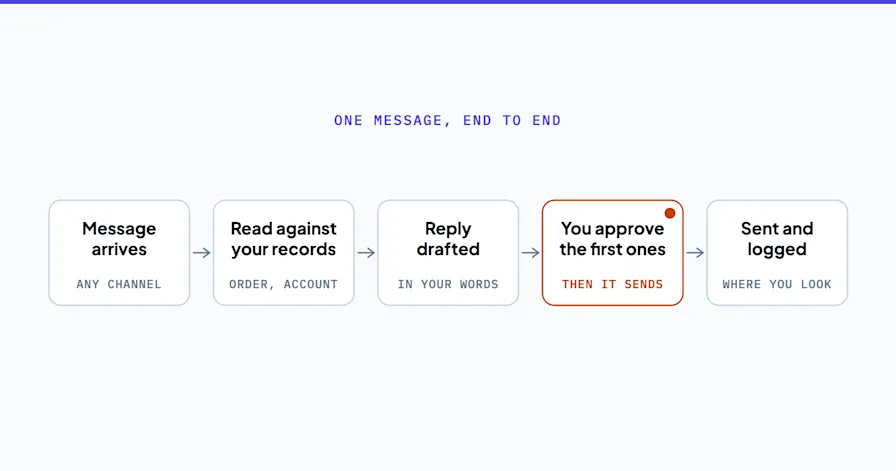
Abstract descriptions of AI capabilities aren't useful. Here is how one inquiry would move through a working agent, step by step.
The inquiry arrives. A customer sends an email or fills out a support form: "I was charged twice for my November subscription and I need a refund."
The agent classifies. The agent parses the intent (billing dispute), checks for urgency signals (tone, keywords like "angry," "canceling"), and routes accordingly.
The agent pulls context. The agent looks up the customer in your billing system. It sees two charges on November 3. It checks subscription history, notices no plan upgrade that would justify a second charge, and confirms this is a real duplicate.
The agent takes action. Based on pre-configured rules, it issues the refund through Stripe, generates a refund confirmation, and logs the action in the support ticketing system.
The agent responds. It writes a response in your brand voice that acknowledges the frustration, confirms the refund, explains what happened, and asks if there's anything else needed.
The agent escalates when it should. If the refund amount exceeds the pre-set threshold (say, $500), or the customer's tone suggests escalation is needed, or the system sees a pattern (three tickets from this customer in 30 days), it routes to a human with full context.
Nobody waits for office hours. The human support team wakes up to a resolved ticket in their queue with a complete audit trail.
This is the shape of what a properly designed AI customer service agent is capable of: end-to-end resolution on the routine work, with a clean handoff when judgment is needed.
Where a Custom Agent Usually Lands First
The customer service case studies you will find online are almost all Vodafone, Amazon, or some global retailer, and none of them tell a twenty person business anything useful. What follows is not a client account and carries no results claims. It is the shape of the work, described by the kind of business that asks for it most often.
A dental or medical practice. The front desk loses its day to reschedules, confirmations and the same handful of insurance questions. An agent trained on the scheduling rules and the routine pre visit questions takes the reschedules and the confirmations, answers what is genuinely routine, and hands anything clinical, or anything that sounds like a complaint, to a person with the history attached. Regulated data changes the architecture rather than the idea: where patient information is involved, the build has to be designed for it from the start.
A small B2B software company. Tier one drowns in two ticket types, billing questions and password resets, while the tickets that actually protect revenue wait behind them. An agent trained on the product documentation, the billing system and the authentication flow clears the routine two, applies a credit inside a limit you set, and flags an unhappy customer to a person instead of quietly closing the thread.
A home services business. Calls out of hours go to voicemail while competitors answer. An agent on the website and the phone line works out how urgent the job is, takes the property details, offers a dispatch slot for the genuine emergencies, and sends a holding reply to everything that can wait until morning.
The pattern is the same in all three. The agent takes the repeating part, the part that follows rules, and it stops where judgment or consequence starts. What that is worth in your business depends on how often the work runs and what a slow answer costs you, which is arithmetic worth doing on your own figures rather than on an industry average. Working it out is the first thing a written roadmap does.
The difference between an agent and an ordinary chatbot decides most of what follows, including what you should be willing to spend, so it is worth settling before the cost comparison. That is the next section.
Chatbot or AI Agent: Which One Your Business Actually Needs
Every vendor selling a chat window now calls it an agent. The label has stopped meaning anything, which matters, because the two things solve different problems and cost different money.
A chatbot holds a conversation. It answers a question, collects a name and an email, points a visitor at the right page. When the conversation ends, whatever it produced sits there until a person picks it up.
An AI agent starts where the conversation ends. It takes what the conversation produced and does something with it in the systems that run the business: books the slot, updates the record, issues the refund, opens the ticket. Where the decision carries consequences it prepares the work and stops for a person to approve it.
How to Tell an Agent From a Chatbot in a Nicer Window
Four signals separate them, whatever the product page says.
It takes action in another system without somebody approving each step along the way.
It carries context between sessions instead of forgetting the customer when the chat closes.
It changes approach when a step fails, rather than sending one message and stopping.
It can be given an objective rather than a script, and work out the path itself.
If the thing you are looking at only generates text in a chat window, it is a chatbot. It may be an excellent chatbot. It is still not going to move work through your business on its own.
When a Chatbot Is the Right Answer
A chatbot is the right buy more often than the people selling agents admit.
The same few questions arrive over and over. Opening times, what is covered, where an order is, roughly what something costs. Answering those automatically takes pressure off the phone without anything in your systems having to change.
You need a first touch, not a resolution. Collecting a name, a company, a budget and a problem statement, then handing the lot to a person or to your CRM, is a legitimate job, and it does not need an agent.
You want cover outside working hours. If the requirement is that somebody responds at nine in the evening, a chatbot meets it.
Nothing downstream is broken. If the work already flows once the information arrives, an agent buys you very little.
When an Agent Earns the Difference
An agent is worth it when the cost is not in answering. It is in everything that has to happen afterwards.
Lead follow up. A form arrives, the inquiry is checked against your criteria and against the CRM, a reply goes out, a call is offered against real availability, and a task lands on the right desk. A chatbot can do none of that.
Client onboarding. One signature triggers the welcome sequence, the account, the questionnaire and the reminders, in order, without anybody chasing the steps.
Appointment lifecycles. Booking, rescheduling, reminders, follow up, review requests. Each piece is small and it never stops.
Back office work nobody sees. Chasing invoices, answering supplier email, assembling the same report every month. Anything that means taking information out of one place and doing something with it in another.
Five Questions That Settle It
Does the interaction have to change something in another system? If it does not, a chatbot is enough.
How many steps does the whole job take? One or two steps inside one tool is chatbot territory. Four or more across several systems is agent territory.
Does the right answer depend on who is asking, or on what happened last time? Context sensitive work needs memory, and memory is agent territory.
How often does the job run? Something that happens all day every day repays a build. Something that happens twice a month rarely does.
What does a missed step cost? A lead nobody answers goes to a competitor. A reminder that never sends becomes an empty appointment slot. The higher that cost, the easier the case for building something that cannot forget.
Most businesses end up with both, in that order: the chat window handles the front door, the agent handles what happens behind it. Which one you need first is a question about your workflow rather than about the technology, and it is the question the free Shortlist Call exists to answer.
Custom AI Customer Service Agent vs Off-the-Shelf Chatbot
The SERP is full of "top 10 AI customer service tools" lists that treat every option as roughly equivalent. They're not. The real choice is about fit to your complexity and compliance needs.
Tier | What It Is | Monthly Cost | Best For | Breaks When |
|---|---|---|---|---|
Rule-based chatbot | Scripted flows | ~$25-50/mo | Simple FAQ, clear paths | Novel questions, context matters |
Help-doc AI | LLM reading your KB (e.g. Intercom Fin, Chatbase) | Per-resolution (~$0.99 each) or flat ($40 to $500 per month, about 20 percent less billed yearly) | Docs-heavy support, medium complexity | Deep multi-system workflows beyond configured integrations |
Custom AI agent | Trained on your data, integrated with your stack | From $20,000 to build, support from $500/mo | Multi-system workflows, brand voice critical, compliance | (Properly built, rarely) |
When off-the-shelf is the right answer. If your support is mostly FAQ, your help docs are comprehensive, and you don't need the agent to take actions in your CRM or billing system, an off-the-shelf AI chatbot for small business will do fine. Tidio or Chatbase can be running in an afternoon.
When custom is the right answer. You need the agent to issue refunds, update accounts, book appointments, or pull data from multiple systems. Brand voice matters (a pre-trained bot that sounds like everyone else won't work for a premium service). You're in healthcare, financial services, legal, or any vertical where data handling matters.
Most small businesses with meaningful support volume end up needing a custom build, or a hybrid where an off-the-shelf tool handles simple routing and a custom agent handles anything requiring integration. Our Virtual AI Employees service is built around this custom approach: agents trained on client-specific data, integrated with the existing stack, and built to the same security standards we apply to every engagement.
What It Takes to Deploy a Custom AI Customer Service Agent
A custom AI customer service agent is not a weekend project. But it's also not a year-long software initiative. It is a scoped build that runs through five stages, and how long it takes depends on how many systems it has to reach into. Here's what the stages look like.
Stage one: data and scope. The agent needs a knowledge base. That means gathering product docs, policies, past support tickets, FAQ content, and any internal playbooks. It also means defining scope: what the agent will handle, what escalates to humans, and where the boundary lives.
Stage two: integration work. The agent gets connected to the systems it needs. CRM, billing, scheduling, ticketing. This is where most DIY deployments struggle, because integration work is where small decisions have big consequences.
Stage three: training and brand voice. The agent gets tuned. Example conversations, brand voice calibration, edge case handling. This is more craft than engineering, and it's where the difference between "works" and "great" lives.
Stage four: human-in-the-loop design. Escalation rules, handoff mechanics, agent-to-human context transfer. The agent should hand a human a complete summary so the human doesn't have to re-ask the customer what's going on.
Stage five: soft launch and tuning. The agent goes live for a portion of traffic. Every interaction is reviewed while the scope is still settling. Issues get patched, scope gets adjusted, brand voice gets refined.
By the end of that last stage, the agent should be handling its designed scope without requiring oversight on every ticket.
Common Failure Modes (And How to Avoid Them)
The AI customer service agents that fail in production tend to fail in the same ways. Watch for these.
Hallucinated pricing or policies. The agent "helpfully" makes up a refund policy that doesn't exist. Fix: strict grounding in the real knowledge base, with refusal behavior when a question falls outside its trained scope.
Broken handoffs. The agent escalates but the human gets no context, so the customer has to explain everything again. Fix: structured context transfer in the ticket, including the agent's interpretation of intent.
Off-brand voice. The agent sounds like every other LLM chatbot, which is especially jarring for premium brands. Fix: deliberate voice calibration in the tuning phase, with specific examples of approved and unapproved responses.
Security and compliance overlooked. A healthcare practice deploys an agent without a Business Associate Agreement. An ecommerce store passes card data through a consumer-grade tool. Fix: architecture review before anything ships. If regulated data is involved, compliance isn't optional.
No monitoring after launch. The agent's accuracy quietly drifts as the business changes. New policies get written but the agent doesn't know. Fix: monthly quality review of a sample of interactions, plus a mechanism for staff to flag bad responses in real time.
AI Customer Service Agent Cost for Small Business
Honest pricing, because nobody in the SERP will give it to you clearly.
Rule-based chatbot (e.g. Tidio): about $24-$49 per month for entry plans, with an AI add-on (Tidio's Lyro) starting around $32.50/month on top. Fast to deploy. Good for simple FAQ. Limited custom actions. (Pricing: tidio.com/pricing.)
Help-doc AI agents: these price two ways. Intercom's Fin charges per resolution, $0.99 per outcome with a 50-resolution monthly minimum and no setup or platform fees (Intercom helpdesk seats, if used, run from $19 to $29 a seat depending on plan). Flat-subscription tools like Chatbase run $40 to $500 per month, about 20 percent less billed yearly, with no per-resolution charge. Enterprise platforms like Ada are quote-based. (Pricing: fin.ai/pricing, intercom.com/pricing, chatbase.co/pricing.)
Custom AI customer service agent: OptiWork publishes a starting figure of $20,000 for a custom agent, and ongoing support, once something is live and you want it looked after, starts at $500 per month. Every project is quoted at a fixed figure before it starts. Predictable, scoped, no per-resolution surprise bills.
What it is worth. That depends on how many tickets arrive, how many of them are genuinely routine, and what a slow answer costs you in customers who do not renew. OptiWork does not publish outcome figures, because the only honest version of that number is the one worked out on your own volumes before anything gets built.
For context on how this fits into broader AI investment decisions, our AI consulting cost guide for small business breaks down pricing by engagement type.
Frequently Asked Questions
What is an AI customer service agent? An AI customer service agent is a software system that understands customer inquiries in natural language, pulls context from your business systems, takes actions to resolve issues, and escalates to humans when judgment is needed. Unlike traditional chatbots that follow decision trees, AI agents reason about what the customer needs and can operate across multiple systems in a single conversation.
How much does an AI customer service agent cost? Rule-based chatbots run about $24-49 per month. LLM-powered help-doc agents price either per resolution (Intercom Fin at about $0.99 each) or as a flat subscription (Chatbase $40 to $500 per month, about 20 percent less billed yearly). OptiWork's own custom agents start at $20,000 to build, with optional ongoing support from $500 per month, quoted at a fixed figure before the work starts. Custom builds have higher upfront costs but lower per-interaction costs at scale.
Can an AI customer service agent replace my support team? Not if you want good support. A well-designed agent handles a meaningful share of routine support volume (FAQ, routine transactions, status checks), which frees the human team to focus on complex cases, relationship-building, and escalated issues. The correct frame is the agent removes repetitive work, not people.
What's the difference between an AI agent and a chatbot? A chatbot follows scripted decision trees. An AI agent reasons in natural language, pulls context from business systems, takes actions (refunds, account changes, scheduling), and escalates when needed. The word "agent" is used loosely in marketing, so ask specifically whether the tool can take actions, not just respond.
How long does it take to deploy an AI customer service agent? Off-the-shelf chatbots can be live quickly, because there is nothing to integrate. A custom agent takes as long as its integrations and its tuning take, which is why the scope is settled and quoted before the build starts rather than guessed at. The work is driven mostly by integration and tuning, not by model training.
Can AI customer service agents handle sensitive or regulated data? Yes, but only if built with the right architecture. Healthcare deployments need BAA-compliant infrastructure and strict data handling. Payment data requires PCI-compliant environments. Off-the-shelf tools usually do not meet these requirements. Custom builds can be designed to compliance requirements from the start.
Key Takeaways and Next Steps
The AI customer service agent category has matured past the early chatbot disappointments. The good ones resolve real support workload, take actions in your systems, and escalate cleanly when a human is needed. But only when the build is right.
Custom AI agents beat off-the-shelf when support requires integration, brand voice, or compliance. Off-the-shelf is fine for simple FAQ deployments.
A chatbot answers. An agent acts. Which one you need is decided by what has to happen after the conversation ends, not by how clever the replies sound.
A well-scoped agent takes routine support volume off your team's plate and hands the rest over with the context attached.
Cost is predictable with custom builds. Custom agents start at $20,000 and are quoted at a fixed figure before the build. Per-resolution platforms can spiral at volume.
Failure modes are avoidable when the build includes real grounding, clean handoffs, brand voice calibration, compliance architecture, and post-launch monitoring.
If you're evaluating whether an AI customer service agent makes sense for your support workload, the fastest way to find out is half an hour with the people who build them. Book a free Shortlist Call and we'll walk through your specific ticket volume, common inquiry types, and what a custom agent could realistically handle. If off-the-shelf is the right answer for your situation, we'll tell you that too.
Small businesses don't need enterprise-scale support operations. They need support that scales without scaling headcount. A well-built AI customer service agent is the closest thing to that reality, and it's more accessible right now than it has ever been.
Sources: Tidio pricing, Intercom Fin pricing, Intercom pricing, Chatbase pricing
Stephen Angelo
Founder & CEO, OptiWork.ai