What Does an AI Consultant Do for Small Businesses?
You already suspect some of your week could be handled by software. What you cannot tell from the outside is whether that means hiring someone, and what an AI consultant would actually do once you did.
That is a fair question to be stuck on. The title covers people who run a prompt workshop and people who rebuild how a company handles its work, and the price range is just as wide.
Here is the plain version. An AI consultant maps how work really moves through your business, decides where software should carry it, designs that system, and builds it. The value is in the decision about what to automate and in what order, not in the tool that ends up doing it.
This article covers what the job involves, what you get at the end of an engagement, and what it costs. It also covers how to spot the people who should not be doing it, and when the honest answer is that you do not need one yet.
What Does an AI Consultant Do, in Plain Terms
An AI consultant looks at how your business runs, finds the places where automation is worth the trouble, ranks them, and builds the ones you agree to. Three parts: work out the sequence, design the system, put it into service.
That definition is easier to trust once you know what the job is not.
It is not prompt work. Getting better answers out of a chat tool is a skill, and it will not stop the same customer address being typed into three systems.
It is not software sales. A consultant who recommends the same platform to everyone is a reseller. The right answer is sometimes an inexpensive off the shelf tool, and sometimes it is changing the process so nothing needs to be bought at all.
It is not one time setup work. Connecting two apps is a task. Deciding which system should own a piece of information, and what happens when it changes, is design work, and it is the part that decides whether the automation survives contact with a busy week.
The order matters more than the tooling. Automating the wrong step first is how automation projects end up quietly shelved, which is why almost every engagement at OptiWork starts with the plan rather than the build.
What Does an AI Consultant Do for You: The Six Deliverables
Six things show up in a well run engagement. Any consultant worth hiring should be able to name all six before you pay anything.
A map of how the work actually moves. Not an org chart. Where information enters the business, where it stops, and where somebody is doing rules based work by hand. The map comes from talking to the people who do the job.
A ranked plan. Which workflow to automate first, which to leave alone, and why. The reasoning is written down so you can argue with it, and so a different developer could pick it up.
The arithmetic on your own figures. A consultant should be doing the sums with your numbers, not quoting an industry average at you. If a figure cannot be established honestly, the plan should say so rather than invent one.
A design, then a build. Which tools do which job, how they connect, and what happens when one of them fails. Then the work itself: the connections between the software you already pay for, so information stops being retyped.
A human approval step where it matters. Where a decision has consequences, the software should prepare the work and stop. It drafts, a person approves, it sends. At OptiWork that is the default rather than an upgrade, because an agent acting unsupervised on customer email is how automation loses people's trust.
Documentation and a handover. You own what was built, in your own accounts, documented well enough for someone else to change it. If the only person who can maintain it is the consultant, you bought a dependency.
Ready to find out which of these your business needs first? Book your free Shortlist Call. No cost, no obligation, and nothing to sign.
What the Engagement Looks Like
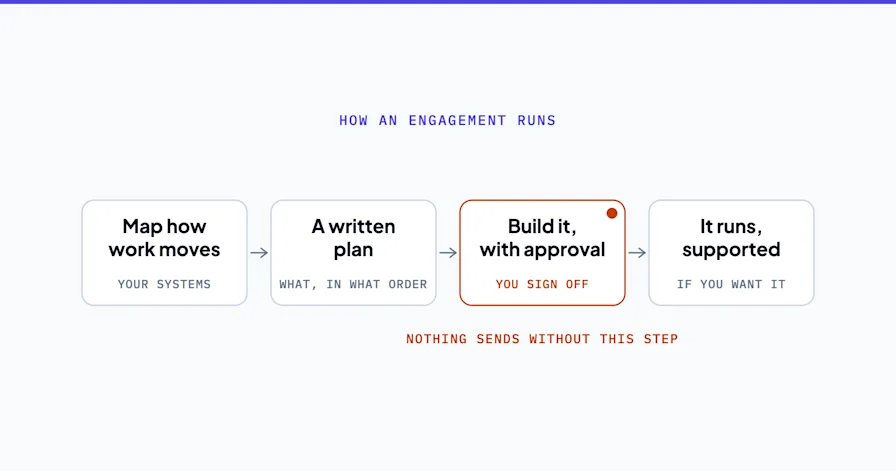
Every consultant structures this differently. Here is how it runs at OptiWork, so you have something concrete to compare other proposals against.
The call comes first, and it is free. Thirty minutes. You leave with a shortlist: the two or three processes in your business most worth automating, in order, and a rough sense of what they would cost and how quickly they would pay for themselves. Nothing is quoted on the call and nothing is signed. If the honest answer is that a process change fixes it for nothing, that is the answer you get.
Then the written plan, if it is worth going further. The AI Roadmap is a fixed $4,500. It contains the process map, the arithmetic on your figures, the ranked plan, and a build specification detailed enough to hand to any developer, with a fixed quote attached. It usually takes two to three weeks, most of which is interviews and checking.
The plan is yours either way. You can build it with OptiWork, give it to your own developer, or take it to another firm and compare like for like. If you do start a build with us within 90 days, the whole $4,500 comes off the cost of that build.
Then the build. Process automation starts at $12,000. A custom agent trained on your own material, tested against your real past cases before it goes live, starts at $20,000. Every project is quoted at a fixed figure before it starts, there is no hourly meter, and no invoice at the end is larger than the figure agreed.
Support is optional and comes later. Monitoring, fixes when a vendor changes something underneath you, and a monthly allowance for small changes, from $500 per month. It is not worth buying before something is live and you depend on it.
What AI Consulting Costs, and How to Read a Quote
Most of the field will not publish a price. Ours are on the pricing page, and the five figures above are all of them.
When you get a quote from anyone else, three questions tell you most of what you need to know.
Is it fixed or is it a meter? An hourly rate on an open ended scope means the discovery you are paying for also decides how long you keep paying. A fixed figure written before the work starts moves that risk onto the consultant, where it belongs.
What decides the number? For connecting existing systems it is usually how many systems are involved and how much they resist being connected. For an agent it is how much judgment the job needs and how clean your past cases are. If a proposal cannot explain what drives its own price, it has not been scoped.
What do you own at the end? A plan you can take elsewhere and systems built in your accounts are worth more than a lower number that leaves you renting access to your own workflows.
One more thing worth saying plainly. The cheapest engagement is the one that ends with "change this process and you will not need software here at all." A consultant who never reaches that conclusion is not looking for it.
When You Do Not Need an AI Consultant
Plenty of businesses should not hire one yet. It is worth knowing which side you are on before you spend anything.
You probably do not need a consultant if:
You need one simple connection, such as a web form that sends an email. Watch a tutorial and build it.
You have one or two tools to join up and somebody on staff who enjoys that sort of thing.
You cannot yet name the workflow that hurts. The free call is a better first move than a paid engagement.
You have your own engineers and a written specification. You want a developer, and it will cost you less.
You are probably ready for one if:
The work spans three or more systems, so somebody is the human integration between them.
You have tried doing it yourself and ended up with automations that break quietly and nobody owns.
The constraint on growth is administrative load rather than demand or skill.
You want a system rather than a pile of disconnected shortcuts.
The real question is whether you need a task automated or a system designed. Tasks are friendly to do it yourself tools. Systems need someone thinking about how each piece affects the next. We wrote a longer comparison of doing it yourself versus hiring a consultant if that is the decision in front of you.
How to Choose One, and What to Walk Away From
The barrier to entry in this field is low, so the evaluation matters more than usual.
Ask what the first two weeks look like. If the answer starts with a platform rather than with your business, keep looking. The sequence is map, design, build. Tools come last.
Check that they work with businesses your size. Enterprise experience does not automatically translate to a company with no IT department and a stack that cannot be ripped out.
Test for vendor neutrality. Ask whether they take commissions from the tools they recommend. OptiWork does not. Ask what they would recommend if your budget were a fraction of what it is, and listen for whether the answer changes.
Ask about data before you have to. Where does your information go, what is encrypted, and does anything you send train a public model. At OptiWork it does not, and where it matters a private model can run on infrastructure you control. Ask anyone else the same question and expect a specific answer.
Look at who does the work. OptiWork is founder led: a 30-year IT veteran with CISSP training, formerly certified for over a decade and now inactive, and the person who scopes the work is the person who builds it. Wherever you go, ask whether the person in the meeting is the person who will do the building.
Ask what you keep. Documentation, accounts, and a plan you could hand to someone else.
Walk away from a proposal that promises to transform your business without naming a single workflow. Walk away from one with no dates attached to deliverables. Walk away from one that never mentions the software you already run, because automation should extend the stack you have rather than replace it. And treat any return figure quoted at you without the arithmetic behind it as marketing rather than analysis.
If you are weighing different kinds of supplier rather than different consultants, the comparison between an automation agency and a consultant is a better place to start.
What Does an AI Consultant Do That You Can Check a Quarter Later
Give it a quarter, then judge it on four things.
What stopped happening. The re-typing, the chasing, the Monday morning triage. If the same tasks are still on someone's desk, the automation did not land where the work actually was.
Whether anything broke quietly. Good builds tell you when a step fails. If you found out from a customer, the design skipped error handling.
Whether your people can run it. Can your staff change a template, add a step, or explain what happens when a form comes in. If only the consultant can, you bought dependency.
Whether the next thing is obvious. A working engagement leaves you knowing what to automate next, because the plan ranked it and the first build proved the approach.
What to Do Next
An AI consultant is worth hiring when the problem is design rather than a missing feature: work spread across systems that were never meant to talk, and no one on staff whose job it is to fix that. The deliverable you are buying is the decision about what to automate, in what order, and what to leave alone.
If you already know exactly what you want built, hire a developer. If you cannot yet name the workflow that hurts, start with a conversation rather than a contract.
Book your free Shortlist Call and you will leave with the two or three processes in your business most worth automating, and a straight answer about whether any of it is worth paying for yet. No cost, no obligation, and nothing to sign.
Stephen Angelo
Founder & CEO, OptiWork.ai