How Much Does AI Consulting Cost for Small Businesses in 2026?
The most common question small business owners ask before hiring an AI consultant isn't "what will you build?" It's "what will this cost me?"
Fair question. And the answer most consultants give, "it depends," isn't good enough.
Here's what AI consulting actually costs for businesses with 1 to 100 employees, broken down by engagement type. You'll get the math you need to figure out whether the investment makes sense for your specific situation. If you want a number specific to your business before reading further, book a free Shortlist Call and we'll give you one.
What AI Consulting Costs for Small Business in 2026
AI consulting for small businesses isn't one thing. It's a range of services with different price points depending on what you need. Here's the landscape based on current 2026 market rates.
The dollar ranges in this article are what I have seen quoted in this market, based on my own experience running these engagements. They are my read of the market, not figures from a published survey.
OptiWork's own pricing is quoted per engagement rather than off a rate card. You can see how that works on the pricing page.
Strategy and roadmap engagements typically run from $2,000 to $15,000 for small businesses. You get a workflow audit, automation roadmap, ROI projections, and a technical architecture plan. This is the "tell me what to do and in what order" engagement. Businesses under $5 million in revenue often start with a focused readiness assessment in the $2,000 to $5,000 range. Most strategy projects take 2-4 weeks.
Full implementation projects range from $5,000 to $50,000+ depending on scope. This covers everything: workflow mapping, tool selection, building the automations, integrating your systems, training your team, and deploying to production. Most small businesses pay $10,000 to $15,000 for a complete 4-6 week implementation that includes automation setup, integration, and training.
Custom AI agent development starts around $8,000 and scales with complexity. A customer support agent trained on your business data, a lead qualification agent that books meetings for your sales team, or an internal knowledge bot that answers employee questions. Each agent is purpose-built, not a template.
Monthly retainers for ongoing optimization run $1,000 to $5,000 per month. This covers monitoring, maintenance, new workflow development, and performance optimization. Not every business needs a retainer. But businesses that treat automation as an ongoing capability rather than a one-time project see better long-term results.
The newer option: Fractional AI advisory. A growing trend in 2026 is the fractional Chief AI Officer model, where a senior AI strategist works with your business 8 to 20 hours per month for $2,000 to $8,000 monthly. It's a middle ground between a one-time project and a full retainer. Useful for businesses that want ongoing strategic guidance without committing to a large engagement.
4 Factors That Determine Your Actual Cost
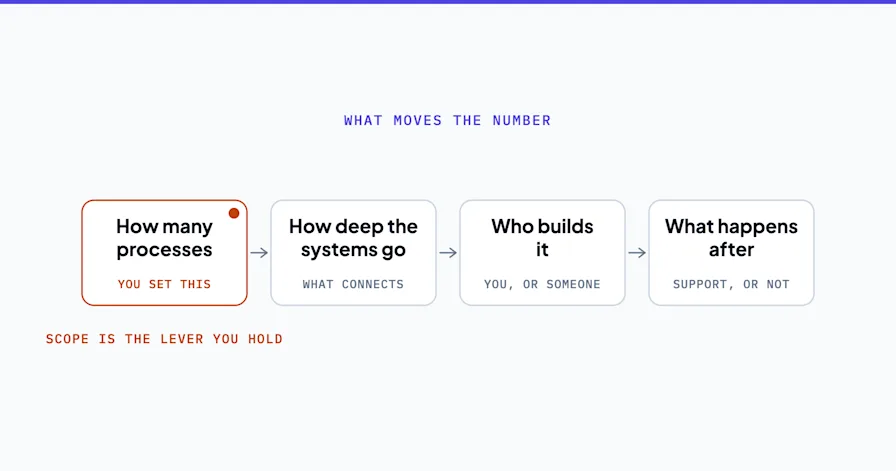
Those ranges are wide on purpose. The AI consulting cost for your small business depends on four things.
Number of Workflows and Systems Involved
A single workflow connecting two tools (say, your contact form to your CRM) is a straightforward project. Connecting your CRM, email, invoicing, scheduling, and project management into one system where every piece talks to every other piece is a different scope entirely.
A 6-person accounting firm that needs automated client onboarding and document routing has a different scope than a 40-person services company that needs lead capture, support routing, invoicing, reporting, and employee onboarding all connected.
More workflows and more systems means more integration work. That's the biggest driver of cost.
Security and Compliance Requirements
If you're in healthcare, legal, or financial services, your setup needs to meet HIPAA, SOC2, or other data handling rules. That adds design work.
This isn't optional overhead. It's the gap between a system that works and one that creates risk. Security-first design costs more upfront but prevents problems that cost far more to fix later. AES-256 encryption, zero retention policies, and private server options are standard for regulated industries.
DIY Hybrid vs. Full-Service
Some businesses want a consultant to build everything. Others want a roadmap they can execute internally with occasional guidance. Both are valid approaches. They just cost differently.
A strategy-only engagement that gives your team a roadmap to follow costs less upfront. But the hidden cost is your team's time and the risk of mistakes during setup. 35% of automation projects fail from weak change management, not technical problems. If your team doesn't have someone who can own the project, the full-service option often saves money in the end.
Complexity of AI Components
Basic rule-based automation (if new lead arrives, send email, update CRM) costs less than AI-powered workflows. AI workflows need models trained on your data, rules for when to escalate to a human, and more testing before launch.
A custom AI agent that resolves 80% of your support tickets requires more development than a Zapier integration that routes emails. Both are valuable. They're just different levels of investment.
The Cost Most Small Businesses Are Already Paying
Here's the number most people skip when weighing AI consulting costs for their small business.
Take a team of ten people. Part of every week goes to repetitive tasks that do not need human judgment. Data entry, follow-up emails, scheduling, invoice processing, report assembly.
Count those hours for one week, honestly, across the whole team. That count is the number this decision turns on, and almost nobody has it written down.
Put your own hourly cost against those hours and you have the only number that matters for your business. Recovering even half of them puts real capacity back on work that earns.
Set the cost of an engagement against the hours it actually takes back. That is the payback arithmetic, and it is worth doing with your own figures before anyone quotes you.
The return is real, but it is specific to the workflow rather than to any published average. What a small business gets back depends on how much repetitive work it actually has and how much of that work runs the same way every time. The roadmap works that number out for your workflows before any build starts.
This isn't theoretical math. A 12-person services firm that automated their lead intake and follow-up saw a 38% increase in qualified consultations within 60 days. The leads were always there. The follow-up wasn't. The automation didn't generate new leads. It stopped the existing ones from falling through the cracks.
How to Calculate AI Consulting Cost vs. ROI for Your Business
Forget general statistics. Here's how to run the math on your specific situation.
Step 1: Pick your highest-impact workflow. The one that costs your team the most hours per week. Lead follow-up, invoicing, onboarding, support triage. Pick the one that hurts the most.
Step 2: Count the hours. How many hours per week does your team spend on this workflow? Be specific. Track it for one week if you haven't before.
Step 3: Multiply. Hours per week x hourly cost per employee x 52 weeks = annual cost of the manual process.
Step 4: Estimate recovery. Most automated workflows recover 60-80% of the manual hours. Multiply your annual cost by 0.7 for a conservative estimate.
Step 5: Compare. If the recovered value exceeds the consulting investment within 3-6 months, it's a clear yes.
For most small businesses, the math works on the first workflow alone. The second, third, and fourth workflows are pure upside.
For a small business, the payback period is the first thing worth working out, and it is worked out from your own hours and your own rates rather than from an industry figure. Start with the workflow carrying the most repetitive volume and the arithmetic usually answers itself.
What to Look for When Evaluating AI Consultants on Cost
AI consulting cost matters. But the cheapest option rarely delivers the best value. Here's what separates a good investment from a bad one.
Vendor-neutral advice. If the consultant pushes one platform no matter what, you're paying for their partnership deal, not your best solution. A good consultant looks at your tools, your team, and your budget, then picks what actually fits. Sometimes that's a $20/month app. Sometimes it's a custom build. The advice should follow the analysis, not the other way around.
Fixed-price scoping. Hourly billing creates perverse incentives. Every question extends the engagement. Fixed-price projects align the consultant's incentive with yours: get results within the defined scope and timeline. Ask for a project quote, not an hourly rate.
Clear deliverables and timeline. "We'll assess your needs and provide recommendations" is not a deliverable. A workflow audit, automation roadmap with ROI numbers, a system diagram, and a timeline with milestones. Those are deliverables. If the consultant can't tell you exactly what you'll have at the end, find one who can.
Security credentials that matter. If you handle customer data (and you do), ask about encryption, data retention policies, and compliance. A CISSP certification means the consultant builds with security from day one rather than patching it on later.
Post-deployment support. The system needs to work after the consultant leaves. That means documentation, team training, and a support window for questions that come up during the first month of real use. If the engagement ends at deployment with no transition plan, you'll be paying for fixes later.
How to Start With AI Consulting Without Overspending
You don't need to commit to a $25,000 project to find out whether AI consulting is worth it for your business.
Start with a free Shortlist Call. A 30-minute conversation that maps your top automation opportunities and gives you a ballpark ROI estimate. No commitment, no sales pitch. Just clarity on where the biggest time and cost sinks are in your operation.
If the call confirms the opportunity, start with strategy. A roadmap engagement gives you a complete plan you can execute on your own timeline. It's the lowest-risk entry point because you get a vendor-neutral document you own, regardless of who implements it.
Then implement sequentially. One workflow at a time. Measure the result. Build on what works. The businesses that see the best results from AI consulting are the ones that treat automation as an ongoing capability, not a one-time project.
The cost of AI consulting for small businesses is real. So is the cost of not doing it. The difference is that one of those costs compounds in your favor.
Book your free Shortlist Call and find out what automation could recover for your business.
FAQ: AI Consulting Costs for Small Business
How much does AI consulting cost for a small business? AI consulting for small businesses ranges from $2,000 to $15,000 for strategy and roadmap engagements, $5,000 to $50,000+ for full implementation projects, and $1,000 to $5,000 per month for ongoing retainers. Most small businesses pay $10,000 to $15,000 for a typical 4-6 week implementation. The cost depends on scope, number of systems involved, and compliance requirements.
Is AI consulting worth it for a business with fewer than 10 employees? Yes, if your team spends 5+ hours per week on repetitive, rules-based tasks. Even a small team recovers significant capacity through automation. A 4-person company reduced their morning email triage from 45 minutes to 8 minutes with a single workflow change.
How long before I see ROI from AI consulting? Most small businesses see break-even within 60-90 days when starting with high-impact workflows like lead follow-up, invoicing, or support routing. Accenture research shows firms can anticipate a 30-200% return during the first year of deploying automation. The average return is $3.50 for every $1 invested.
Can I implement the roadmap myself instead of paying for full implementation? Yes. A strategy-only engagement gives you a vendor-neutral roadmap you can execute at your own pace. Many businesses implement the first 1-2 workflows internally and bring in a consultant for the more complex integrations.
Stephen Angelo
Founder & CEO, OptiWork.ai